Have you ever noticed how good it feels to take a deep breath at the beach? There’s something about salty ocean air, the sound of the waves and a few uninterrupted moments of relaxation that seems to invite us to slow down. That familiar experience may be part of the appeal behind a growing wellness practice known as dry salt therapy, or halotherapy, an experience that brings microscopic particles of dry salt into the air we breathe. But what actually happens during a salt therapy session, and what does the science tell us about its potential benefits?
From Salt Mines to Salt Rooms
The story of modern salt therapy begins deep underground.
In the 19th century, Polish physician Dr. Feliks Boczkowski observed that workers in Poland’s Wieliczka Salt Mine appeared to experience fewer respiratory problems than workers in other types of mines. His observations helped inspire the use of underground salt-mine environments as therapeutic settings, a practice known as speleotherapy. The Wieliczka Salt Mine eventually became a health resort, and other underground salt mines and caves throughout Eastern Europe were similarly used as health and wellness destinations.
For more than a century, people continued to explore whether the distinctive environment of these underground spaces might influence respiratory health. Then, in the 20th century, technology made it possible to bring the concept above ground.
Modern halotherapy uses a device called a halogenerator to grind dry sodium chloride into microscopic particles and disperse them into an enclosed room or chamber.
Today, you can find salt therapy far from the mines where the practice began, from wellness centers and medical spas to hotels, fitness facilities and even private homes.
What Is Dry Salt Therapy?
Halotherapy is a complementary wellness practice in which people sit or relax in an enclosed environment while breathing air containing microscopic particles of dry sodium chloride.
Halotherapy differs from familiar forms of saline treatment such as nasal sprays, saline rinses and nebulized saline, which use salt dissolved in water. Halotherapy uses an aerosol of dry salt particles.
In an active salt therapy room, a halogenerator breaks high-purity sodium chloride into tiny particles and disperses them into the air. Particle size matters because smaller particles can travel farther into the respiratory tract.
One proposed mechanism involves the hygroscopic nature of salt—its ability to attract moisture. When inhaled, dry salt particles may interact with mucus lining the airways, potentially loosening secretions and making them easier to clear through coughing. This is one reason respiratory health has been the primary focus of much of the halotherapy research.
But here’s an important distinction:
A plausible biological mechanism is not the same thing as proven clinical effectiveness.
Understanding what happens in the body is one part of the story. Determining whether a therapy actually improves health outcomes is another.
What Does the Research Tell Us?
There is a genuine body of international research involving salt-based respiratory therapies, including studies conducted in Europe and elsewhere over several decades. Researchers have investigated approaches related to halotherapy and salt inhalation in conditions such as asthma and chronic obstructive pulmonary disease (COPD).
Some findings are encouraging. A 2021 review examined research concerning halotherapy and asthma and reported potentially beneficial findings. However, the review also included studies involving different forms of salt or saline exposure, not all of which were equivalent to modern, active-room halotherapy. That distinction matters when interpreting the findings.
Research involving COPD illustrates why the quality and design of evidence matter as much as the number of studies. A 2014 review concluded that the evidence available at the time was insufficient to recommend halotherapy as a treatment for COPD and called for better-designed clinical trials.
So, where does that leave us?
The research isn’t absent, but neither is it conclusive.
Studies conducted in Europe and elsewhere have explored halotherapy for respiratory conditions and other health concerns, and some have reported encouraging results. At the same time, medical experts note that the evidence is limited by the number and quality of rigorous clinical trials, and some newer findings have been less encouraging.
In other words, dry salt therapy is an intriguing complementary wellness practice, but scientists are still determining exactly where and how much it may help.
For now, halotherapy is best viewed as a complementary practice rather than a replacement for established medical treatment.
What About Skin Health?
Skin benefits are among the claims frequently associated with salt rooms. Providers may promote halotherapy for concerns such as eczema, psoriasis and acne.
Here, however, it’s important not to confuse different types of salt-based therapies.
There is research involving salt baths, Dead Sea treatments and other forms of balneotherapy for certain skin conditions. Those interventions cannot automatically be applied to dry salt aerosol in a halotherapy room. They are different therapies with different methods of delivery.
For dry salt therapy specifically, evidence supporting significant benefits for skin conditions remains limited. Cleveland Clinic’s review of the subject notes that there aren’t sound studies establishing many of the commonly promoted skin benefits of salt rooms.
That doesn’t mean someone couldn’t enjoy the way their skin feels after a session. It simply means we shouldn’t confuse an enjoyable experience with a clinically established treatment.
Can Salt Therapy Help You Relax?
Many salt rooms are designed as tranquil spaces, with subdued lighting, comfortable chairs, quiet music and a peaceful atmosphere. A typical session may give you something increasingly rare in modern life: 30 to 45 minutes when you aren’t expected to answer a message, complete a task or be somewhere else.
That alone can be restorative.
Cleveland Clinic’s Melissa Young, MD, makes an important observation: a calming salt-room environment may help people relax, but the same benefit might occur without the salt itself.
So rather than claiming that salt therapy treats anxiety, it may be more accurate to say that the experience can provide an opportunity for relaxation and stress reduction, while the specific contribution of the salt aerosol to those effects remains uncertain.
Salt Cave, Salt Room or Salt Booth?
Although these terms are sometimes used interchangeably, they can describe somewhat different environments.
Salt Caves

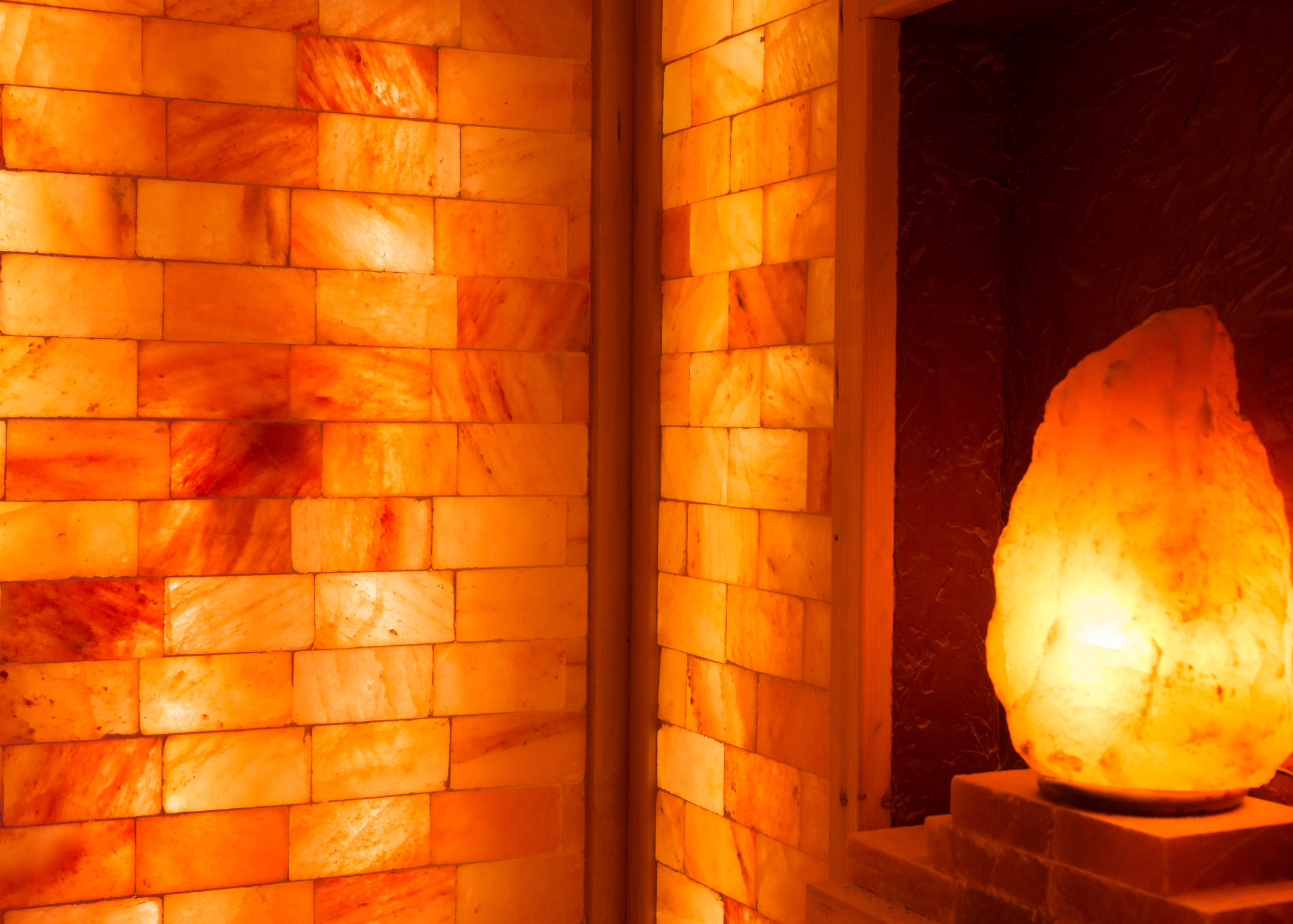
Salt caves are designed to recreate the appearance and atmosphere of natural salt caves or mines. They may feature salt-covered walls, floors, rock formations and soft lighting. Some accommodate several people and emphasize an immersive, relaxing experience.
But don’t judge a salt cave by its décor alone. The important question is whether it uses a halogenerator to actively disperse dry salt aerosol.
Salt Rooms

Salt rooms are enclosed spaces designed for salt therapy, relaxation or both. Some are contemporary spaces lined with salt bricks or panels; others are designed to resemble underground salt caves.
An active salt room uses a halogenerator to disperse microscopic dry salt particles into the air. A passive salt room may contain salt walls, floors or other décor without generating a therapeutic salt aerosol.
The distinction matters if you’re specifically seeking halotherapy.
Salt Booths

Salt booths are smaller, more private enclosures designed for individual or limited-use sessions. Their smaller volume may allow for shorter sessions than those offered in larger rooms.
Again, however, the appearance of the space doesn’t tell you whether you’re receiving active halotherapy. If that’s what you’re seeking, ask whether a halogenerator is being used.
Where Can You Find Salt Therapy?
Dry salt therapy has moved well beyond specialized salt caves. Today, it may be offered in:
Longevity and wellness centers
Medical and day spas
Luxury hotels and resorts
Fitness centers
Equine therapy centers
Private homes
Some facilities combine salt-room sessions with meditation, yoga, massage, sound therapy or other wellness experiences. These combinations can create a relaxing multisensory experience, although the benefits of those additional practices shouldn’t automatically be attributed to the salt.
Home-use equipment is also available, but consumers should understand what a particular device actually does before assuming it provides the same type of controlled dry salt aerosol used in active halotherapy.
Active or Passive? A Question Worth Asking
If you’re considering salt therapy, this may be the most useful distinction to remember:
Salt décor isn’t the same thing as active halotherapy.
The Salt Therapy Association’s industry standards distinguish active halotherapy from salt used simply as decoration. Its standards call for a professional-quality halogenerator, controlled particle size, an enclosed space, appropriate ventilation and high-purity dry sodium chloride. The organization also states that Himalayan salt used on walls or floors as décor does not itself constitute salt therapy.
A passive salt room may still be a beautiful and relaxing environment. But if you’re paying specifically for halotherapy, you deserve to know whether you’re receiving an active salt aerosol treatment.
Before You Book: A Consumer’s Guide
A few simple questions can help you understand what you’re actually paying for.
Does the room use a halogenerator?
If the answer is no, you’re likely experiencing a passive salt environment rather than active halotherapy.
What kind of salt is used?
The Salt Therapy Association’s industry standards call for highly purified dry sodium chloride for use in a halogenerator.
How is the room ventilated?
Appropriate ventilation and air exchange are part of the industry’s recommended standards.
How long does a session last?
Sessions vary according to the size of the room, equipment and facility protocols. Longer isn’t necessarily better.
What health claims does the provider make?
Be cautious if a business promises to cure diseases, replace medications or deliver guaranteed results. Responsible providers should acknowledge that the scientific evidence is still evolving.
What happens if you have a medical condition?
If you have a significant health condition, are pregnant or have concerns about how halotherapy might fit into your current care, talk with your healthcare professional before beginning.
Is Dry Salt Therapy Safe?
For generally healthy people, a salt-room session appears to be relatively low risk, but “natural” doesn’t necessarily mean risk-free.
Some people may experience increased coughing during or after a session as inhaled particles interact with mucus in the airways. People with claustrophobia may also find smaller rooms uncomfortable.
Most importantly, halotherapy should not replace prescribed medications, inhalers or other medical treatment. If you have asthma, COPD, cystic fibrosis or another respiratory condition, or high blood pressure, discuss complementary therapies with your healthcare provider rather than changing an established treatment plan on your own.
Another consideration is the lack of universally accepted clinical protocols. Researchers have noted that there are not yet standardized guidelines establishing the appropriate dose, frequency or treatment protocol for salt-room halotherapy.
In other words, if you’re interested in trying it, choose your facility thoughtfully—and approach it as a complementary wellness practice, not a substitute for medical care.
The Bottom Line
Dry salt therapy has an intriguing history, a growing presence in the wellness world and a body of international research that deserves continued attention. Some studies suggest potential respiratory benefits, particularly involving mucus clearance and aspects of lung function, but the evidence isn’t yet strong or consistent enough to consider halotherapy an established treatment for specific diseases.
Evidence for dry salt therapy’s effects on skin conditions or anxiety is even less conclusive.
That doesn’t mean you can’t enjoy a salt room.
For some people, the attraction may be the salt aerosol. For others, it may be the chance to sit quietly in a beautiful environment and breathe a little more deeply. And sometimes, giving ourselves permission to slow down may be a worthwhile wellness practice all by itself.
If you’re curious about dry salt therapy, approach it with the same healthy curiosity you bring to any wellness trend: ask questions, understand what you’re actually receiving, look for responsible providers and keep the science and your regular healthcare firmly in the picture.
After all, we don’t have to know that something works conclusively before we can be curious about it. We simply need to be honest about what we know and what we’re still learning.
References
Cleveland Clinic. (2025, April 21). Could salt therapy improve your health? Health Essentials. https://health.clevelandclinic.org/salt-cave-benefits
Crisan-Dabija, R., Sandu, I. G., Popa, I. V., Scripcariu, D.-V., Covic, A., & Burlacu, A. (2021). Halotherapy—An ancient natural ally in the management of asthma: A comprehensive review. Healthcare, 9(11), 1604. https://doi.org/10.3390/healthcare9111604
Rashleigh, R., Smith, S. M. S., & Roberts, N. J. (2014). A review of halotherapy for chronic obstructive pulmonary disease. International Journal of Chronic Obstructive Pulmonary Disease, 9, 239–246. https://doi.org/10.2147/COPD.S57511
Salt Therapy Association. (2019). Dry salt therapy (halotherapy): Reference & resource guide—Clinical studies and medical research. https://www.salttherapyassociation.org/images/STA-Reference-and-Resources-Guide-022819-RED.pdf
Salt Therapy Association. (2022, November 28). Salt Therapy Association launches Salt Therapy Industry Standards. https://www.salttherapyassociation.org/blog/salt-therapy-association-launches-salt-therapy-industry-standards
Wasik, A. A., & Tuuminen, T. (2021). Salt therapy as a complementary method for the treatment of respiratory tract diseases, with a focus on mold-related illness. Alternative Therapies in Health and Medicine, 27(S1), 223–239.